




![Mehrere Bündel an Kräutern sind als eine Girlande nebeneinander gereiht. Darüber steht [...].](https://aw-tiertherapie.de/wp-content/uploads/2025/10/AdobeStock_317992881_Preview-removebg-preview.webp)
FAQs
Do you have questions? Maybe some of our FAQs already have the answer you are looking for 😊
If not, don’t hesitate to contact us.
Why a mobile practice?
And what’s your service area? 🚐
A mobile practice has many advantages.
You don’t have to travel far, your pet stays in its familiar surroundings and is therefore much less stressed, and it’s easier for me to understand issues that only arise in or around specific places or everyday situations, which gives me a better sense of your pet’s daily life. Plus, you don’t have to lug around as much equipment 😉🤭
- Niefern-Öschelbronn
- Pforzheim
- Enzkreis
- Vaihingen-Enz
- Calw
- Bad Wildbad
- Nordschwarzwald
- Schwarzwald Mitte
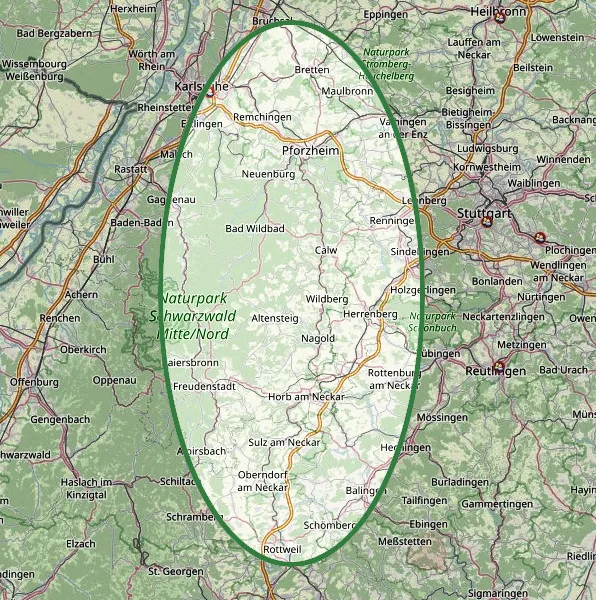
Up to 15km one way is included. For every distance above 16km there is a call-out charge of 1,00€ per two kilometres driven.
What happens during an initial appointment for veterinary naturopathy 🌿?
We’ll meet in the stable car park or at your home.
Please don’t take your horses/donkeys/equines out of the stable beforehand – we’ll do that together once the formalities have been sorted and most of the medical history has been covered, so your pet won’t have to stand at the grooming area for too long 😉
Dogs and cats are free to roam around your flat and do their ‘thing’ whilst we two-legged folk have a chat and sort out the paperwork 😊
During the medical history interview, I’ll ask you loads of questions. Sometimes about things that might seem unrelated, because I want to get a comprehensive picture of your pet’s everyday life. Please make sure you set aside plenty of time for this.
After all, the work of a veterinary naturopath depends largely on how much information is provided. Sometimes, the seemingly smallest details lead to the ‘solution’ to the case in question.
After the medical history, we move on to the general examination. This involves measuring the pulse, respiration and temperature, palpating the entire animal and its lymph nodes, and auscultating the heart and lungs. Once this data has been recorded, we move on to a gait analysis and a specialised examination.
The nature of the specialised examination depends on the specific ‘issue’ your pet is experiencing. This may involve testing individual nerves, applying pressure to specific TCVM diagnostic points, or taking laboratory samples depending on your pet’s individual needs.
Once we have gathered all the necessary information, we will move on to the treatment. This is tailored to your pet’s individual needs, which is why I am unfortunately unable to provide a general description of the process here.
If you’ve made it through this detailed description, you’ll no doubt have come to realise that an initial appointment takes some time.
Please allow at least 90 minutes (probably a bit longer) everything has been discussed and assessed.
What happens at a first animal PT appointment 🦴💪🏼?
We’ll meet in the stable car park or at your home.
Please don’t take your horses/donkeys/equines out of the stable beforehand – we’ll do that together once the formalities have been sorted and most of the medical history has been covered, so your four-legged friend won’t have to stand at the grooming area for too long 😉
Dogs and cats are free to move about your flat and do their ‘thing’ whilst we two-legged folk have a chat and sort out the paperwork 😊
First, we’ll start with a comprehensive medical history. After that, I’ll have a look at your pet and give them a quick, superficial palpation.
I’ll then observe their gait and palpate them again, for example to check for differences in temperature; this always provides valuable information and is an important part of my examination routine during a physiotherapy appointment.
If any particular symptoms emerge during the examinations so far, I may carry out more specific tests. However, this is actually quite rare.
An equipment check, joint tests and tests of selected fascial lines, on the other hand, are a standard part of my repertoire. The transition between these tests and treatment is quite seamless. This is because it often makes sense to treat the affected area straight away and then retest it.
A wide variety of techniques are used for manual treatment, e.g. classic massage techniques and joint mobilisation, Dorn techniques, fascial release, manual lymphatic drainage (where required or appropriate) or, amongst others, the Search-Stay-Release method according to Masterson.
Where appropriate or necessary, physical therapies are then applied. I use a low-level laser, a magnetic field device, KT tape or cupping glasses – depending on your four-legged friend’s individual needs.
To ensure lasting changes can take place, I’ll discuss and demonstrate some simple exercises if needed, which are essentially intended as ‘homework’ exercises 😊
If you’ve made it through this detailed description, you’ll surely have come to understand that an initial appointment does take some time.
=> An initial appointment for a dog or cat lasts between 60 and 90 minutes.
=> An initial appointment for a horse or donkey lasts between 90 and 120 minutes – the difference in size compared to a dog really makes itself felt in terms of the area to be worked on and the time required 😉🤭.
What happens at a first training session 💪🏼🧠?
We’ll meet in the stable car park or at your home. Depending on whether we’ve had a previous appointment, we may or may not start with a brief discussion of your pet’s history.
After that, we’ll move to the next seating area, because for our pets to learn properly, we two-leggers first need to talk about behavioural learning and facial expressions, and do a few dry runs on the topic of trainer training. After all, the aim is for you, as the pet owner, to be able to practise these exercises yourself and independently with your pet 😊
We’ll then start laying the practical foundations for effective training. Depending on how much concentration you and your pet still have left, we’ll cover basic manners around treats as well as introduce the first target.
If you already have experience with positive reinforcement and clicker training, what we cover in the first session will, of course, be adapted accordingly.
Afterwards, we’ll discuss the training homework, and then hopefully we’ll see each other at the next training session 😊 Happy practising!
What happens during a follow-up appointment for veterinary naturopathy 🌿?
As with the first appointment, we’ll meet in the stable car park or at your home. Immediately afterwards, we’ll go and collect your horse / donkey / equine from the stable, if necessary.
Depending on how the initial appointment went and what your pet’s specific issue is, the follow-up appointment will be slightly different.
If laboratory tests were requested, the results should usually have come back by then and been analysed by me. We’ll then discuss these in detail.
To begin with, we’ll have another chat so that I can gauge whether the treatment is working as planned or whether, following a further examination, we may need to take a different approach.
We’ll then move on to the general and specific examination, followed by treatment.
Please note that a follow-up appointment must take place within 8 weeks of an initial appointment; otherwise, a new initial examination will be required.
What happens at a follow-up animal PT appointment 🦴💪🏼?
As with the first appointment, we’ll meet in the stable car park or at your home. Immediately afterwards, we’ll go and collect your horse / donkey / equine from the stable, if necessary.
Depending on how the initial appointment went and what your pet’s specific issue is, the follow-up appointment will be structured slightly differently.
We’ll start by having a chat again so that I can get an idea of what has changed since the last appointment.
We’ll then proceed with the general and specific examination, followed by treatment. Afterwards we’ll discuss any homework exercises for your pet, if any are necessary.
Please note that a follow-up appointment must take place within 8 weeks of an initial appointment; otherwise, a new initial examination will be carried out.
What happens at later training sessions 💪🏼🧠?
Just as with our first session, we’ll meet in the stable car park or at your home.
We’ll get straight into the training session, so please do get your horse ready beforehand and, if necessary, book a round pen or a similar space so that we won’t be disturbed.
Depending on how far we’ve got with the training in previous sessions, we’ll assess where we’re at and either continue from there or start something new.
This depends entirely on the progress made in training.
Please don’t put any pressure on yourself. Learning takes time, and it’s better to invest more time in the basics at the start and achieve lasting success in training than to rush through things and end up with your horse not really understanding what you want from them – that would be a real shame.
Do you treat animals other than dogs 🐶, cats 🐱, horses 🐴 or donkeys?
I’m afraid I can’t give a blanket answer to that. It always depends entirely on the type of animal in question.
If I’ve no knowledge of the specific anatomy, I’m afraid I won’t be much use to your pet.
But please do ask. I’m constantly attending further training courses and devouring specialist books, so perhaps I’ve expanded my knowledge and can help your pet after all 🥰
What to do if your pet has an emergency? 🚑️🤕
Is it an actual emergency?
Here you can find a brochure from the Bundestierärztekammer as a download. It tells you what constitutes an actual emergency.
For cat / dog owners:
Do you live near Pforzheim? Please read this:
Telephone number of the veterinary emergency network for the Enzkreis and Pforzheim: 07231 1 33 29 66
Do you live near Calw? Please read this:
Here you can find the emergency website of the veterinary practice Bammel: https://www.tierarzt-bammel-calw.de/im-notfall/
Do you live near Freudenstadt? Please read this:
The emergency service page for Hummel Veterinary Practice: https://www.kleintierpraxis-hummel.de/Notdienste
The homepage of Baumer Veterinary Practice also lists the details of the practice on duty: http://www.tierarzt-baumer.de/
Do you live near Böblingen? Please read this:
Here you can find the veterinary emergency services for Böblingen: https://www.kleintiernotdienst-bb.de/
Do you live near Rottweil? Please read this:
Here you can find the emergency website of the small animal veterinary practice Dr. vet. med. Bergmann: https://www.tierarzt-rw.de/index.php?id=notafll
For horse / donkey owners:
Horse veterinary clinic Salzhofen – in Bretten:
Their mobile Practice is 24/7 on call: 07252 9364-0
Horse veterinary clinic Maichingen – in Sindelfingen:
Their mobile Practice is 24/7 on call: +49 (0) 7031 385-120
Here is their Website: https://pferdeklinik-kleintierpraxis.de/tierarzt-pferdeklinik.html
Horse veterinary clinic Iffezheim:
They have a Website specifically for emergencies: https://www.pferdeklinik-rennbahn.de/de/pferdeklinik/notfaelle.html
This is their number: 07229 3035-0